
 Sogelau Tuvalu is an American Samoan athlete, who briefly found fame at the World Athletics Championships in Daegu, South Korea in 2011. Having failed to make the entry standard for the shot put, as the fastest runner in is high school, Tuvalu was chosen by his coach to compete in the 100 metres, for which no such standard existed for his country.
Thus, on August 27, 2011, Tuvalu, lined up in the fourth heat of the preliminary round of the 100 metres at the Daegu Stadium. Aged just 17, not wearing running spikes and, according to the Daily Mail, ‘twice the size of the other six competitors’, the youngster was fighting a losing battle right from the gun. Commensurate with his pre-race odds, of 50,000/1, Tuvalu was always a long way last and trailed in 4.89 seconds behind the winner, Malaysian Mohammed Noor Imran Hadi.
Nevertheless, Tuvalu ran hard all the way to the finish line, even managing a dip finish, and was rewarded with a personal best time of 15.66 seconds. In slightly breathless, but nonetheless enthusiastic, trackside interview with BBC Sports broadcaster Sonja McLaughlan, he said that his first experience of international competition was ‘really fun’ and, despite his obvious limitations, described athletics as a ‘cool sport for me’. Tuvalu later told French television that he had devoted four hours a day for a month to his preparation for the World Championships and described his participation as ‘a dream come true’.
Remarkably, 15.66 seconds is not the slowest time for the 100 metres recorded at the World Athletics Championships. On August 2, 1997 in Athens, Greece, Kim Collins of Saint Kitts and Nevis ‘ran’ his heat in a time of 21.73 seconds alhough, in his defence, he suffered an injury mid-race, slowed to a walk and limped across the line.
 Jonah Lomu, who died unexpectedly in November, 2015, at the age of just 40, after suffering a heart attack, was hailed as the first international superstar in rugby union. Lomu suffered from a rare kidney condition, known as nephrotic syndrome, which hampered his playing career and, ultimately, contributed to his death.
Lomu made his international debut, playing one the wing, for New Zealand against France at Lancaster Park, Christchurch on June 26, 1994, less than two months after his nineteenth birthday; in so doing, he became the youngest player ever to play for his country, beating the previous record set by inside centre Edward Wrigley in 1905. However, it was at the Rugby World Cup, hosted by South Africa, the following year that Lomu rose to prominence.
Standing 6’5″ tall and weighing in at 18 stone or more, Lomu was well-built, muscular and blessed with exceptional speed and nigh on unstoppable in full flight. He was particularly devastating in the semi-final against England in Cape Town, scoring four tries in a 45-29 victory, which led opposing captain Will Carling to call him ‘a freak’. New Zealand eventually lost the final 15-12 to the hosts at Ellis Park Stadium, Johannesburg, but Lomu was nonetheless named as ‘Player of the Tournament’.
At the 1999 Rugby World Cup, principally hosted by Wales, he scored eight tries to break the record for the most tries in a single tournament. All told, his 63 international caps yielded 37 tries, 15 of which came at the Rugby World Cup, making Lomu the joint-highest try scorer, alongside South African wing Brian Habana, in the history of the tournament.
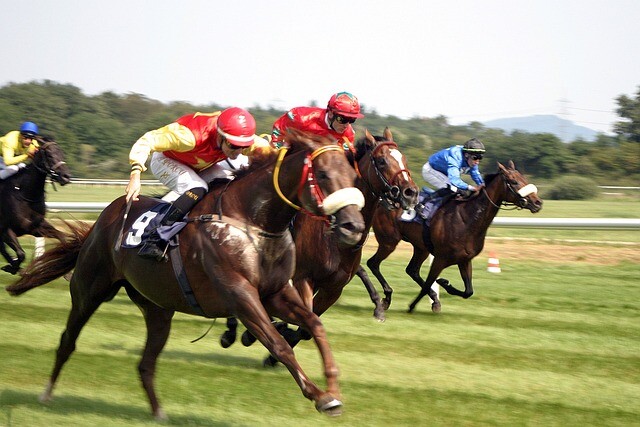 Born in Wantage, Berkshire on November 5, 1935, Lester Piggott was the greatest Flat jockey of his era and was held in awe by many of his horse racing contemporaries. He rode his first winner in Britain, The Chase, at Haydock in August, 1948, and his last, Palacegate Jack, at the same Merseyside track in October, 1994. In the intervening 46 years, Piggott rode 4,493 winners, and became Champion Jockey eleven times, including eight years running between 1964 and 1971. Many following Lester Piggott betting tips over the years, will certainly have been pleased to be a fan!
Piggott was uncommonly tall for a Flat jockey, at 5′ 8″, and his height, together with his idiosyncratic, short riding style, led to him being nicknamed the ‘Long Fellow’. He was also famously tight-lipped, mainly due to a hearing impairment and slight speech impediment, and was known, less kindly, as ‘Old Stone Face’. Piggott enjoyed fruitful associations with three of the most successful trainers in the history of British Flat racing, namely Sir Noel Murless, Vincent O’Brien and Sir Henry Cecil, and won 30 English Classics; he remains the leading jockey in the history of the Derby, with nine wins between 1954 and 1983. Many followers of his rides, would be looking to see the open times of their local bookmaker in order to lump on.
Remarkably, Piggott also remains, far and away, the most successful jockey in the history of Royal Ascot, with 116 victories, including a record 11 in the Gold Cup, in an era when the Royal Meeting was confined to four days. He also rode Nijinsky, trained by Vincent O’Brien, to victory in the 2,000 Guineas, Derby and St. Leger in 1970, thereby completing the English Triple Crown.
Piggott retired from race riding for the first time in 1985, but was subsequently found guilty of tax fraud and sentenced to three years’ imprisonment, of which he served just over a year. He came out of retirement in 1990, famously winning the Breeders’ Cup Mile at Belmont Park, New York on Royal Academy, also trained by Vincent O’Brien, less than two weeks after his return to the saddle. He also won the 2,000 Guineas in 1992, on Rodrigo De Triano, trained by Peter Chapple-Hyam, before retiring for a second, and final, time in 1995.
 Introduction
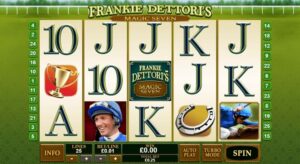
Frankie Dettori’s Magic Seven is a 5 reel, 25 payline slot with thrilling horse racing style bonus rounds and a jackpot of 7,777 times your wager.
In the game, players can win up to 7,777x their investment if they match 5 wild Frankie Dettori symbols on the reels at the same time. Players can also win 10x their investment for matching three lower-value playing card icons.
Whenever two Magic Seven symbols appear on the reels, a scatter payout of 1x your total bet will be triggered. However, the real action comes in the free spins bonus round which triggers when three or more Magic Seven symbols appear. There is also a pick bonus round which triggers when two race course symbols appear on the first and last reels.
Bonus Feature
With some luck, Frankie Dettori’s Magic Seven’s two bonus features can prove to be highly rewarding.
In the Free Games Race bonus, players are transported to a new screen when three Magic Seven symbols appear anywhere on the screen. In this game, players must select one of three horses to participate in a virtual race, and the position of the chosen nag in the race will determine how many free spins they will then receive. A horse that finishes last receives ten spins, but a horse that finishes second gets 15 spins. You’ll be rewarded with 35 free spins if you win the race, so you could build up some big payouts.
There is also a Magic Seven bonus game that is triggered by the race track symbol rather than the Magic Seven symbol. As a result, players are taken to a racetrack divided into 20 sections, where a prize will be revealed based on their choice of a section. You can win coins in certain sections, while revealing trophies plays a video and increases your multiplier. The feature will end when you find “collect”.